What’s this about?
This site is an official rules reference for Red Rising by Stonemaier Games.
It’s great for finding a specific rule quickly. It’s also an excellent supplement to the rulebook included in the box, when watching a how-to-play video, or while teaching the game.
Usage Tips
Back & Forward Nav: Think of each rule entry as a separate webpage. If you want to jump back, hit your Back button.
Check the Index : Don’t see what you’re looking for? The Index has every term in the game.
Install it: This site is a (Progressive Web App). You can install it as a standalone app that is lightning fast, and works even when you’re offline.
Link to a rule: Want to share a link to a particular rule? Just click its title!
Credits
Designed by Jamey Stegmaier and Alexander Schmidt
Art by Jacqui Davis, Miles Bensky, and Justin Wong
Based on the novels by Pierce Brown
©2014 Pierce Brown, Inc. All Rights Reserved. Tabletop rights reserved by Stonemaier Games.
- Last checked
Turn Overview
On your turn, either lead or scout.
Lead: Deploy a card from hand face up on a location, triggering its deploy ability (if any). Then do one of the following:
Gain the top card from another location, then gain that location’s bonus.
Gain the top card of the deck, then roll the Rising die and gain the resulting bonus.
Scout: Reveal the top card of the deck and place (not deploy) it on any location. Gain that location’s bonus.
Iconology
| End-Game VP | ||
|---|---|---|
| Jupiter. Advance once on the Fleet track. | VP on track | |
| Mars. Gain 1 Helium. | 3 VP each | |
| Luna. Gain (or keep) the Sovereign token. | 10 VP | |
| The Institute. Place 1 Influence on the Institute. | 4/2/1 VP each | |
| End-of-game scoring ability | ||
| Banish the top card of a location. | ||
| Reveal the top card of the deck and place (not deploy) it on any location. | ||
| Block an opponent's attempt. | ||
Characters
 4D Painter
 Administrator
 Aegis Craftsman
 Aja
Aja Alfrun
 Alia Snowsparrow
 Antonia
 Arlus
Arlus Artificer
 Artisan Chef
 Ash Lord
 Assassin
 Auctioneer
 Banker
 Bondilus
 Boneriders
 Bridge
 Calliope
 Cassius
 Ceo
Ceo Codebreaker
 Colonel Valentin
 Conversationalist
 Cyther
 Dancer
 Danto
Danto Darrow
 Dataport Specialist
 Deanna
 Developer
 Diplomat
 Dr. Virany
 Eo
Eo Evey
Evey Firewall Expert
 Fitchner
 Garden Trained Rose
 Gardener
 Gravboot Cobbler
 Group Counselor
 Hacker
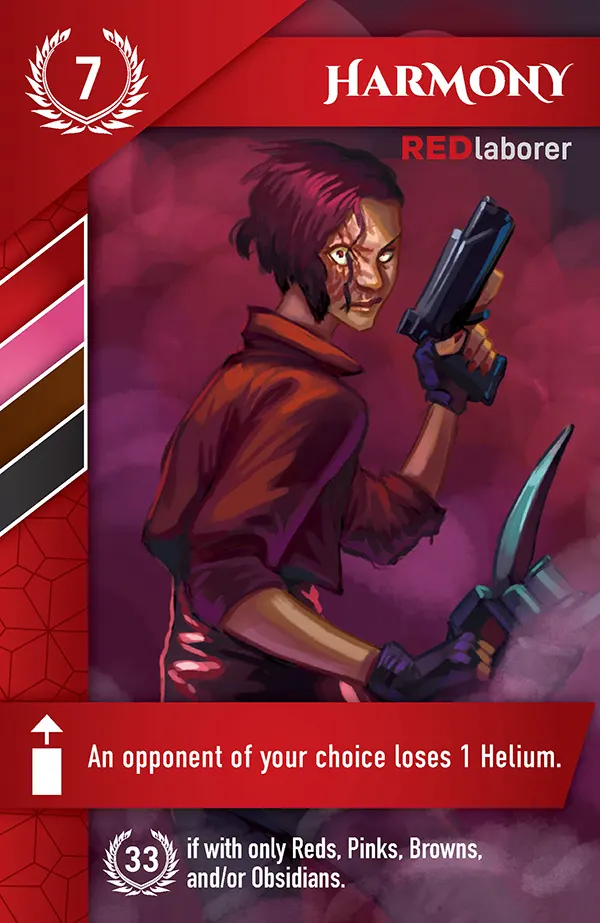
 Harmony
 Helga
Helga Holiday
 Holo Designer
 Holo Host
 Hypnotist
 Investor
 Invictus
 Janitor
 Jopho
Jopho Judge
Judge Justice
 Karnus
 Lawyer
 Loan Shark
 Lorn
Lorn Lysander
 Magistrate
 Martyr
 Masseuse
 Matteo
 Mess Hall Cook
 Mickey the Carver
 Modjob
 Morning Star
 Musician
 Mustang
 Nanny
Nanny Nero
Nero Octavia
 Online Gambler
 Orator
 Orion
Orion Pathologist
 Pax au Telemanus
 Pelus
Pelus Politician
 Priestess
 Psychologist
 Pulse Armorer
 Pulse Fist Engineer
 Quicksilver
 Quietus
 Ragnar
 Razor Designer
 Reporter
 Researcher
 Romulus
 Roque
Roque Seer
Seer Sefi
Sefi Sevro
Sevro Sponsor
 Stained
 Stock Broker
 Sun-Hwa
 Surgeon
 Tactus
 The Howlers
 The Jackal
 The Pax
 The Telemanuses
 Theodora
 Timony
 Trigg
Trigg Ugly Dan
 Uncle Narol
 Victra
 Virga
Virga Vlogger
 Zanzibar
End of Game
The game ends when all 3 of these conditions are met by any player or any 2 conditions are met by the same player:
- a player has 7 or more Helium
- a player has 7 or more Influence on the Institute
- a player reaches 7 or more on the Fleet Track
Finish taking turns until each player has taken the same number of turns in the game. If Apollo is an active house, they take the last turn (this is an extra turn).
During end-game scoring, for each card in your hand beyond the 7th card, you lose 10 VP.
Components
-
60 Helium tokens (red gems)

-
60 Influence tokens
(10 tokens in 6 different colors) -
6 Fleet tokens
(1 ship in 6 different colors) -
1 first-player token
(crescent moon) -
1 Sovereign token

-
112 character cards

-
6 house tiles
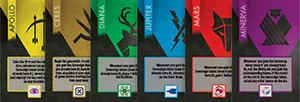
-
1 game board
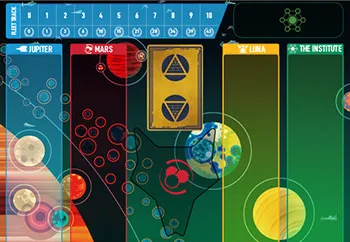
-
1 scorepad
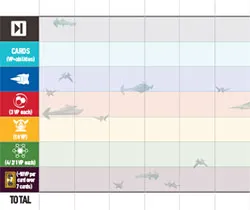
-
1 custom Rising die

-
6 reference cards
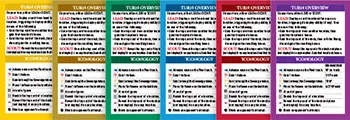
Setup
Before doing any of the normal setup steps of a 2-player game:
Shuffle the 22 normal Au Toma cards to form the face down Au Toma deck and set the topmost 4 off to the side for later use.
-

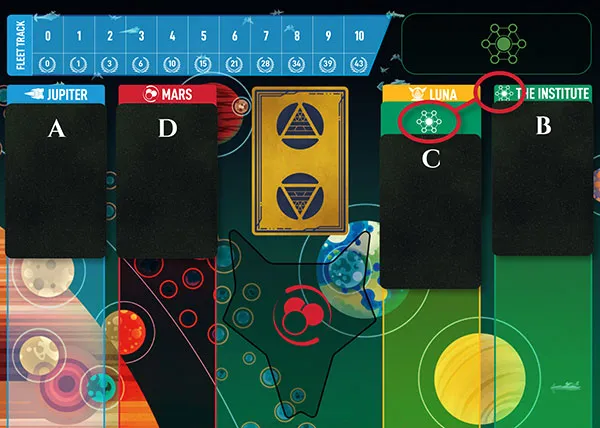
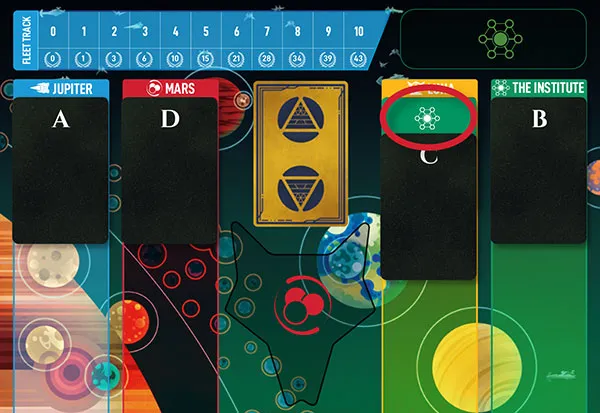
Shuffle the 4 priority cards and place 1 face up at the top of each location.
A is the highest priority and Au Toma will use that location most often, while D is the lowest priority, corresponding to the location she will use the least.
-
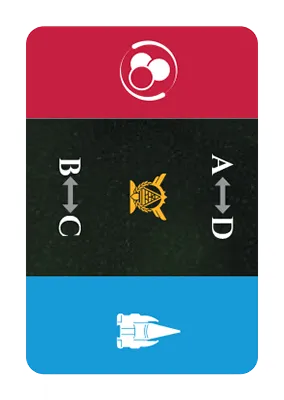
Tuck the Luna bonus card below the priority card at Luna so that only 1 of the card’s icons is visible.
If Luna has the A-priority card, then the visible icon should be the icon of the location that has the D-priority card and vice versa.
If Luna has the B-priority card, then the visible icon should be the icon of the location that has the C-priority card and vice versa.
Example
-
Remove the following character cards from the game: Auctioneer (Copper), Eo (Red), Loan Shark (Silver), Psychologist (Yellow), and Roque (Gold) from the game.
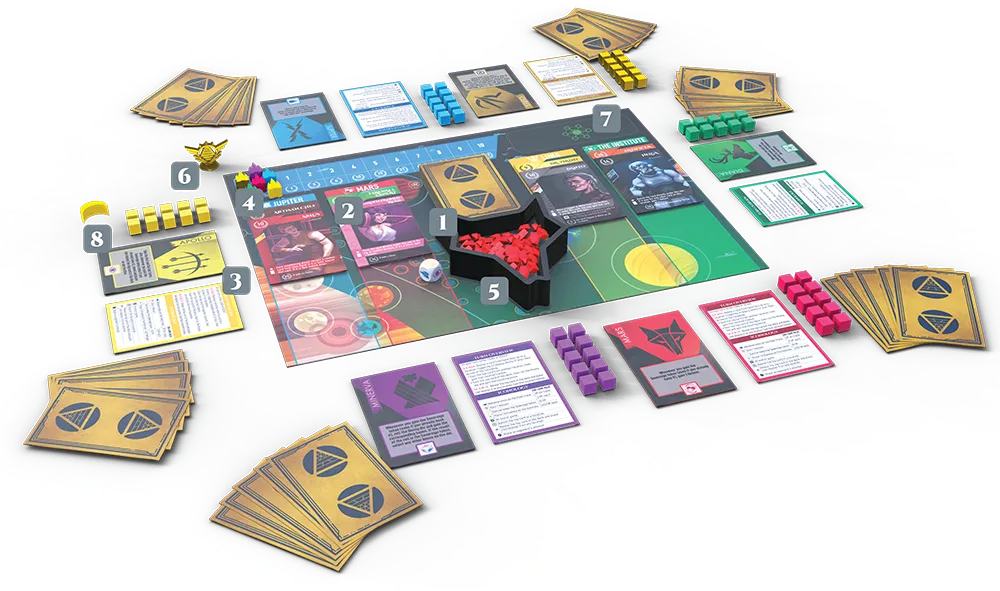
Place the board on the table. Shuffle the deck of character cards and place it face down on the board. Place the Rising die next to the deck.
On each location (Jupiter, Mars, Luna, and The Institute), place 2 character cards from the deck face up. These cards overlap so only the VP, name, and color of the covered cards are exposed. (Note: Players may look at cards on locations at any time.)
-
Draw 5 character cards from the deck to form your starting hand. Your hand of cards is kept private throughout the game. Next, gain a random house tile. Gain the reference card, Fleet token, and Influence tokens of the matching color. Then set up the rest of the board as indicated here:
Au Toma starts with a hand (deck) of 2 character cards, as opposed to the normal 5, and she does not gain a house. The cards in her hand are face down.
Place your house's Fleet token on the 0 space on the Fleet Track.
Place all Helium tokens in the designated spot below the deck to create the supply.
Place the Sovereign token nearby. This represents the leader of the Society.
Start with your house's 10 Influence tokens in your personal supply (you'll try to place them on the Institute during the game).
For 2-player games, place 3 influence tokens of an unused house into The Institute. This represents a neutral house, making end-game scoring more competitive.
If a player has House Apollo (yellow), give them the first-player token; otherwise, randomly select a player and give them the first-player token. They can proceed to take their first turn. The first-player token will remain in that player's possession throughout the game.
 Take the odd/even card and tuck it partially below the bottom of the board so that either “ODD” or “EVEN” sticks out, corresponding to whether there are most cards with an odd or even core value on the board (in case of ties pick “EVEN”). That side stays face up for the rest of the game. Note that 0 is an even number.
Shuffle the deck and place it on the board, along with the Rising die. Place 2 face-up cards on each location.
Draw 5 cards. Then gain a random house tile and the corresponding 10 Influence tokens. Place your Fleet token on the 0 space of the Fleet Track.
Anatomy of a Character Card
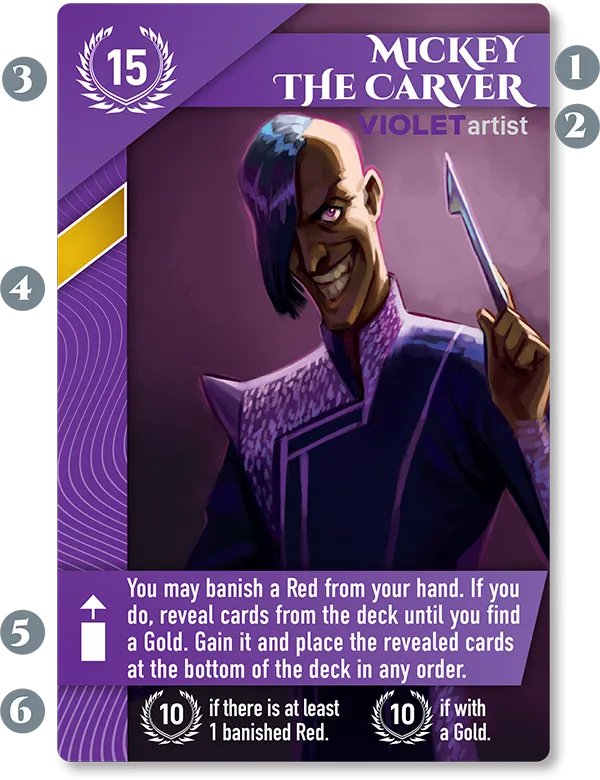
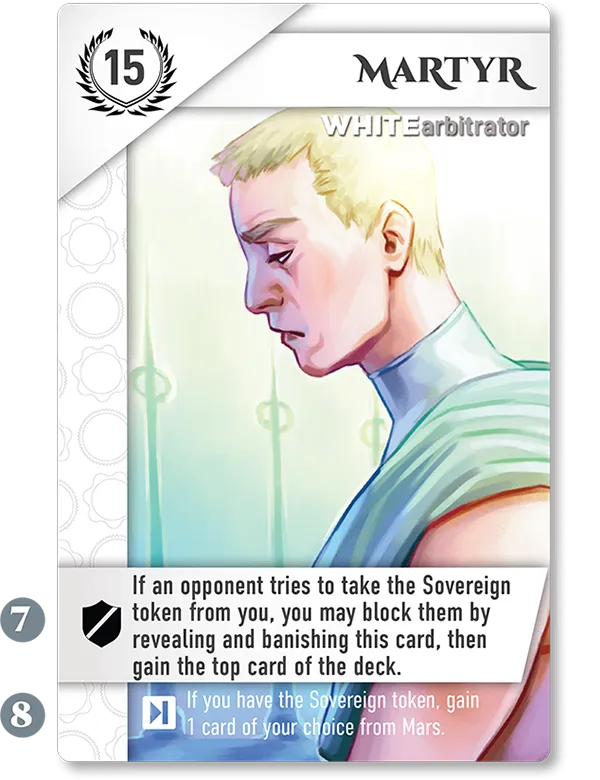
Name
Color. The color of a character card represents the caste of the character.
Core value (end-game points)
Characters this card wants (solid) and doesn’t want (X) in hand. This is a visual reference for text elsewhere on the card.
Deploy ability ().
End-game bonuses and points (). If a card refers to colors or specific characters (e.g., “if with a Red,” “if with no Blues,” “for each Gold”), it’s referring to the other cards in your hand.
Block ability (). This is an optional ability that requires you to reveal a card to prevent an opponent’s attempt to do something to you.
End-of-game ability ().
Colors
The color-based societal structure of the dystopian Red Rising world is an allegory for the racial struggles of the past and present in the real world. It’s a cautionary tale of what can happen when people are judged by the color of their skin instead of the content of their character.
Banish a Card
To banish a card means to remove it from the game (for now). There is an area near the board for banished cards (all face up and visible to players). Banished cards are in no particular order.
Block Ability
This is an optional ability that requires you to reveal a card to prevent an opponent’s attempt to do something to you.
The Deck
The deck is not a location, but if you choose to draw a card from the deck instead of one of the four locations during the lead action, you roll the Rising die, which grants you a mandatory bonus.
Deploy Abilities
The deploy abilities of some cards instruct you to “end your turn.” This indicates that you may not proceed to gain the top card of a location or the deck and the corresponding bonus.
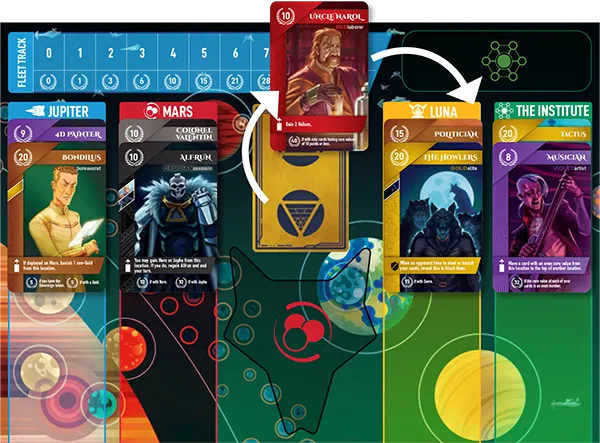
The deploy abilities of some cards may move the card you’ve deployed to a different location. You are still considered to have deployed to the original location.
Some deploy abilities mention “another location,” referring to any other location than the one on which the card was deployed.
The deploy ability of some cards may instruct you to deploy another card. As usual, deploy that card face up on any location and trigger its deploy ability (if any). This concludes the deployment. You may still perform the final step of the lead action only once.
If it’s not possible for you to use the deploy ability of a card, you may still deploy it and ignore the ability.
If a card instructs you to move or place a card, it does not count as a deploy.
Deploy actions that result in a trade of resources may only be taken once per turn (e.g., Sponsor, Stock Broker).
Game End
The end of the game is triggered when all 3 of these conditions are met by any combination of players or when any 2 conditions are met by the same player:
 A player has 7+ Helium tokens
 A player has 7+ Influence on the Institute
 A player reaches or surpasses 7 on the Fleet Track
Finish taking turns until each player has taken the same number of turns in the game. If Apollo is an active house, they take the last turn (this is an extra turn). Then proceed to scoring.
Your Hand
You start the game with a hand of 5 cards. Your hand of cards is kept private throughout the game.
During scoring you lose 10 points for each card in your hand beyond the 7th card.
There is no hand limit.
House Tiles and the Sovereign Token
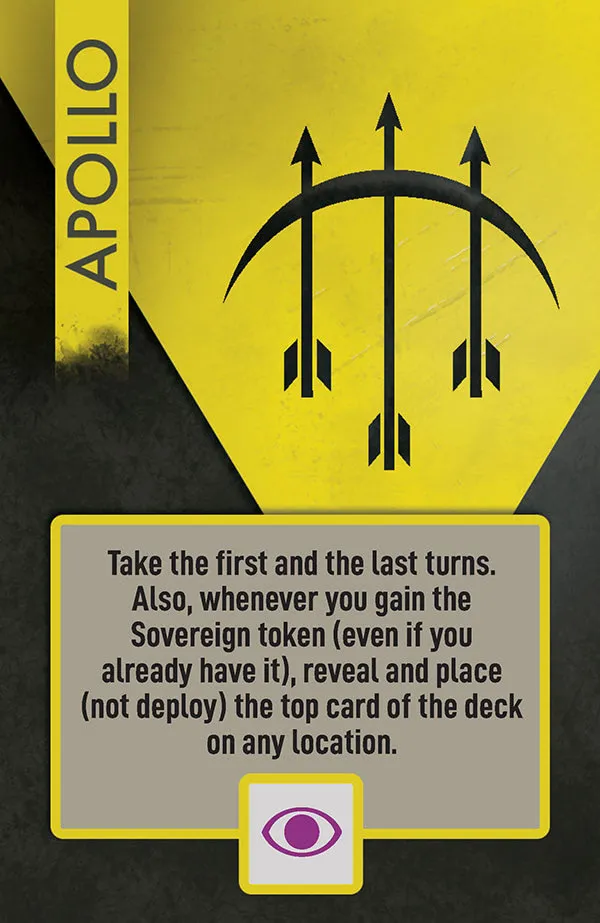
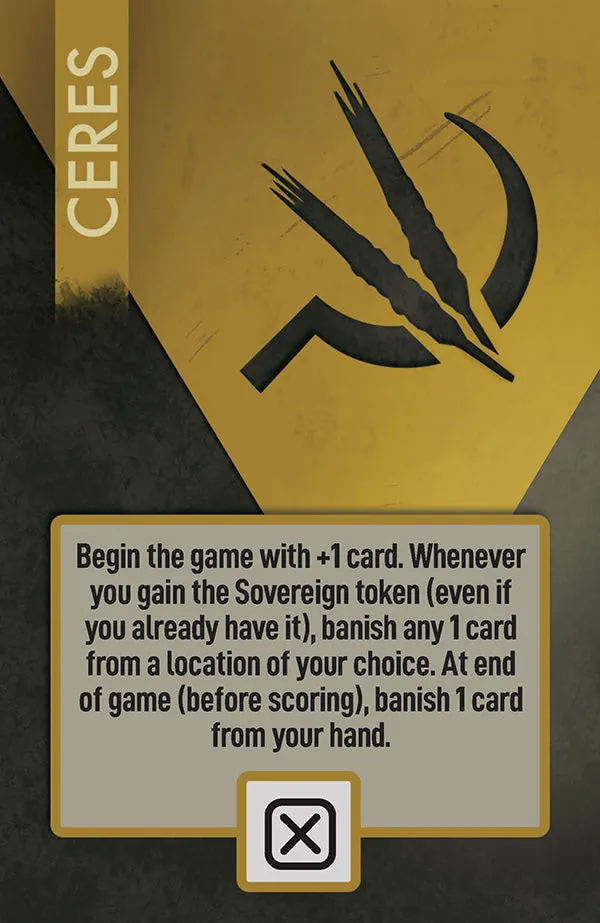
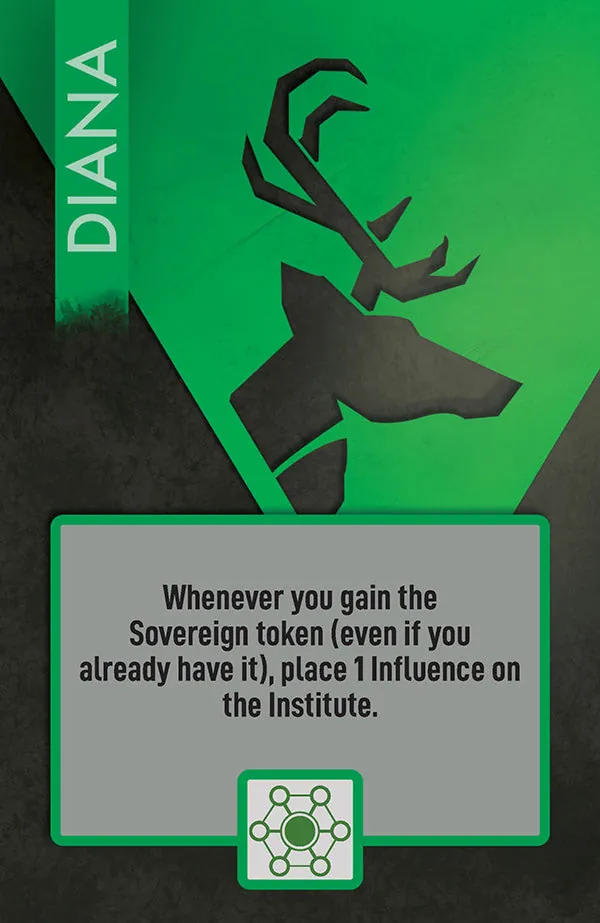
Each house tile has an ability that is triggered whenever you gain the Sovereign token (even if you already have it). Typically this will happen by gaining a card from Luna, but it also applies to any card ability from which you would gain the Sovereign token, as well as rolling Luna on the Rising die. First gain the Sovereign token, then trigger the ability. These house abilities are mandatory, not optional.
Apollo
-
Take the first and the last turns. Also, whenever you gain the Sovereign token (even if you already have it), reveal and place (not deploy) the top card of the deck on any location.
Ceres
-
Begin the game with +1 card. Whenever you gain the Sovereign token (even if you already have it), banish any 1 card from a location of your choice. At end of game (before scoring), banish 1 card from your hand.
Diana
-
Whenever you gain the Sovereign token (even if you already have it), place 1 Influence on the Institute.
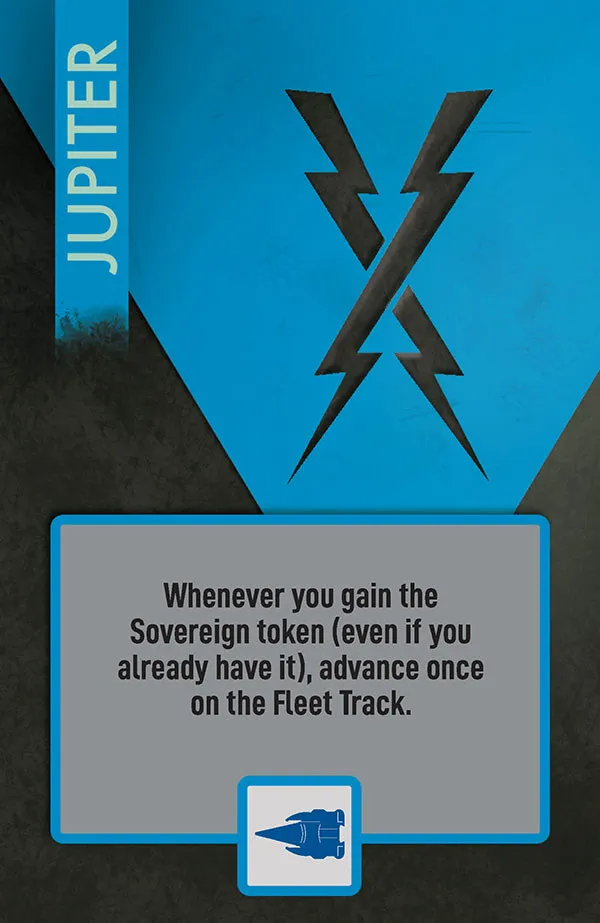
Jupiter
-
Whenever you gain the Sovereign token (even if you already have it), advance once on the Fleet Track.
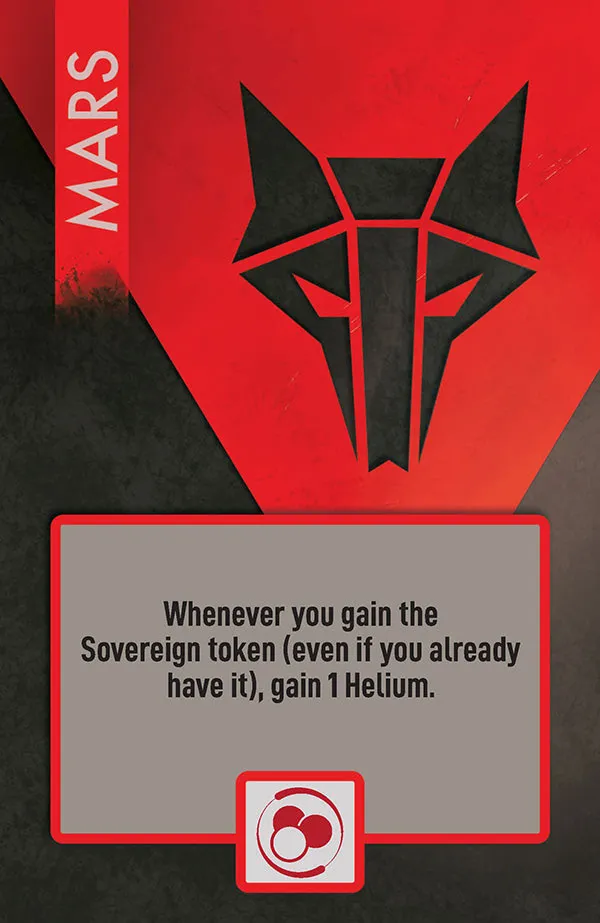
Mars
-
Whenever you gain the Sovereign token (even if you already have it), gain 1 Helium.
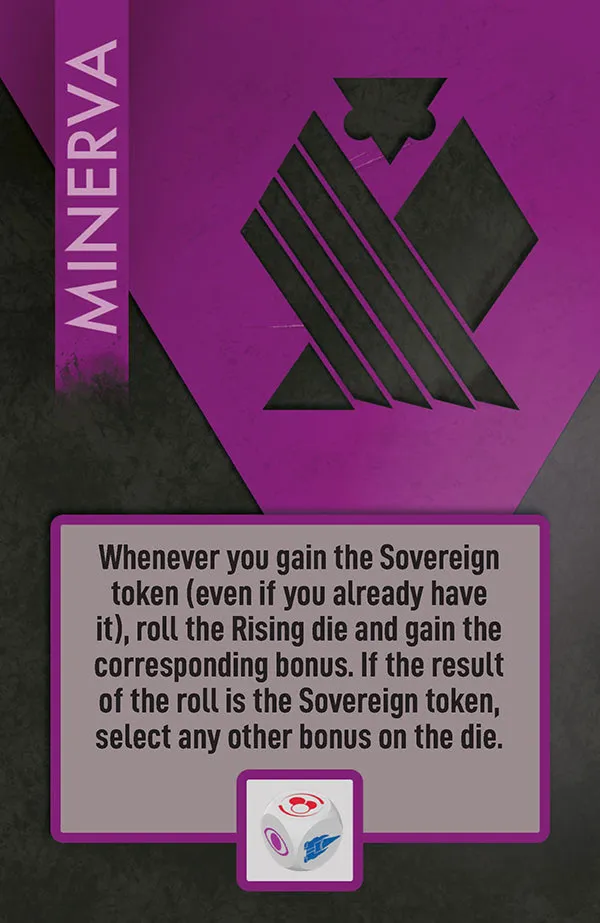
Minerva
-
Whenever you gain the Sovereign token (even if you already have it), roll the Rising die and gain the corresponding bonus. If the result of the roll is the Sovereign token, select any other bonus on the die.
Lead Action
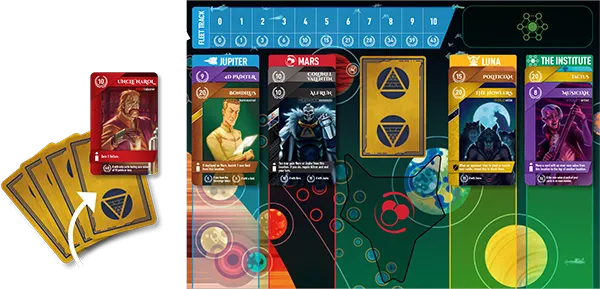
On your turn, either lead or scout. When you lead:
Select a card from your hand.
-
deploy it face up on any location, covering all but the name, color, and core value of the topmost card at that location.
If possible, trigger the deploy ability () of the card played, unless it gives you the option not to (e.g., “You may gain…”).
Then, either:
Gain the top card of a location that you did not deploy to this turn, then gain that location’s bonus.
Gain the top card of the deck, then roll the Rising die and gain the resulting bonus.
Locations
The 4 locations in the game are Jupiter, Mars, Luna, and The Institute. The deck is not a location.
After you gain a card from 1 of the 4 locations during the lead action or place a card from the deck on a location during the scout action, you must also gain that location’s bonus (if possible):
Jupiter
Advance once on the Fleet Track. If you have reached the end of the Fleet Track, you may not advance further.
Mars
Gain 1 Helium token. There is no limit to Helium tokens. If the supply is empty, use a suitable replacement.
Luna
Gain (or keep) the Sovereign token. This triggers the ability on your house tile.
The Institute
 Place 1 of your Influence tokens on this space. If you’ve already placed all 10 of your tokens, you can’t place more.
Reveal
To reveal a card means to show it to all opponents. Unless otherwise instructed, the card returns to your hand.
Rising Die
- Banish the top card of a location of your choice.
- Reveal the top card of the deck and place (not deploy) it on any location.
- Gain (or keep) the Sovereign token. This triggers the ability on your house tile.
- Gain 1 Helium token. If the supply is empty, use a suitable replacement.
- Advance once on the Fleet Track.
- Place 1 Influence on The Institute. If you’ve already placed all 10 of your tokens, you can’t place more.
Scoring
Use the scorepad to tally each player’s score step by step in this order:
End-of-game abilities
Starting with the first player, trigger all of your end-of-game abilities in an order of your choosing. Continue clockwise with the next player until all players have triggered these abilities.
“You may treat this card as if its name alone is the same as a specific character.”
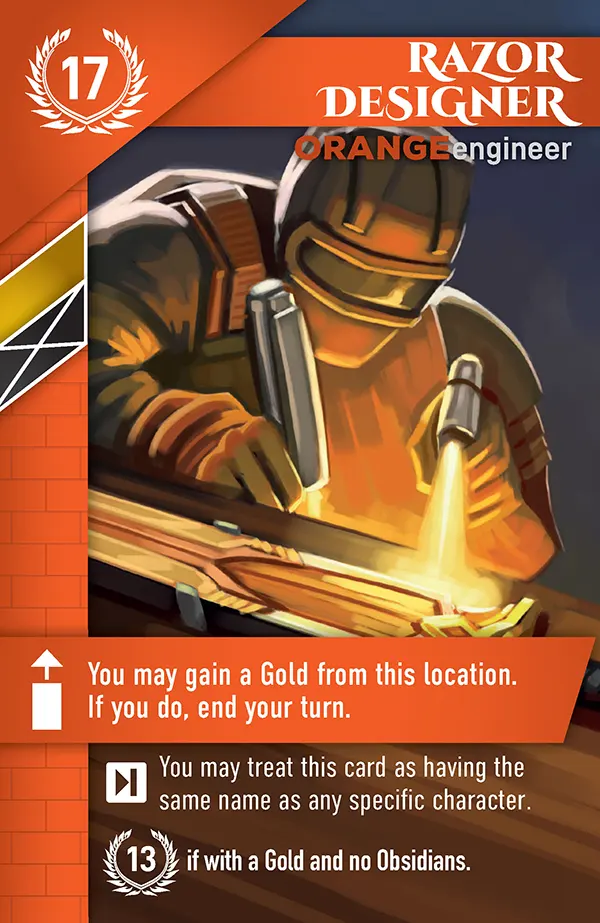
This text, seen on Orange cards, lets you change the name of the card to another character’s name. So if you have a card that scores points if it’s with Darrow, but you don’t have Darrow, you can rename an Orange card “Darrow” to score those points. Otherwise, all other aspects of the Orange card stay the same (i.e., you don’t also copy the Darrow character card’s points and ability). You do not score extra points for having multiple cards with the same name.
“You may treat this card as if it is any one other color (in addition to Gray).”
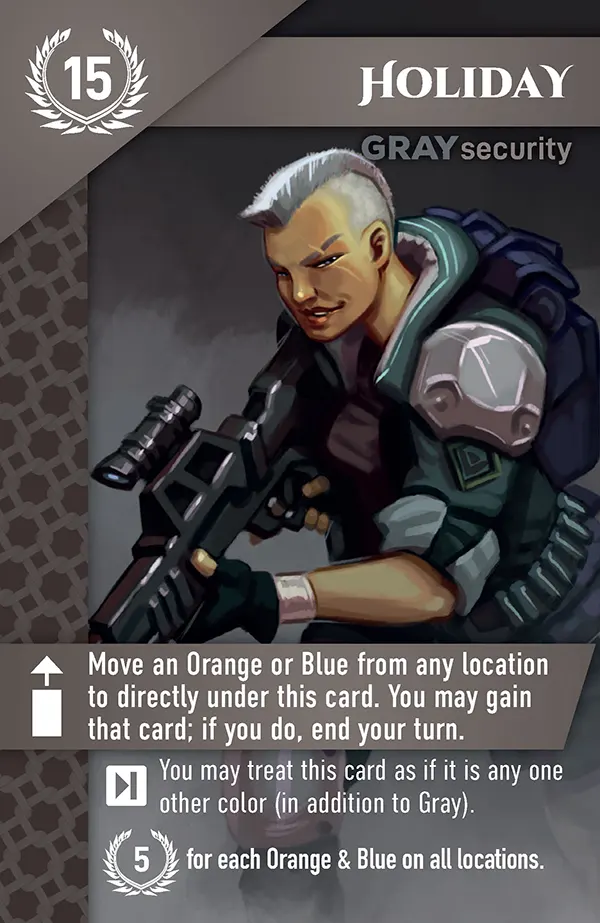
This text, seen on Gray cards, lets you treat each Gray card as an additional color (i.e., to score more points if a card needs or values another color).
Character Cards
Look at the cards in your hand. Add together the core value of each card (upper left) and points gained or lost from end-game bonus points (bottom).
“for each”
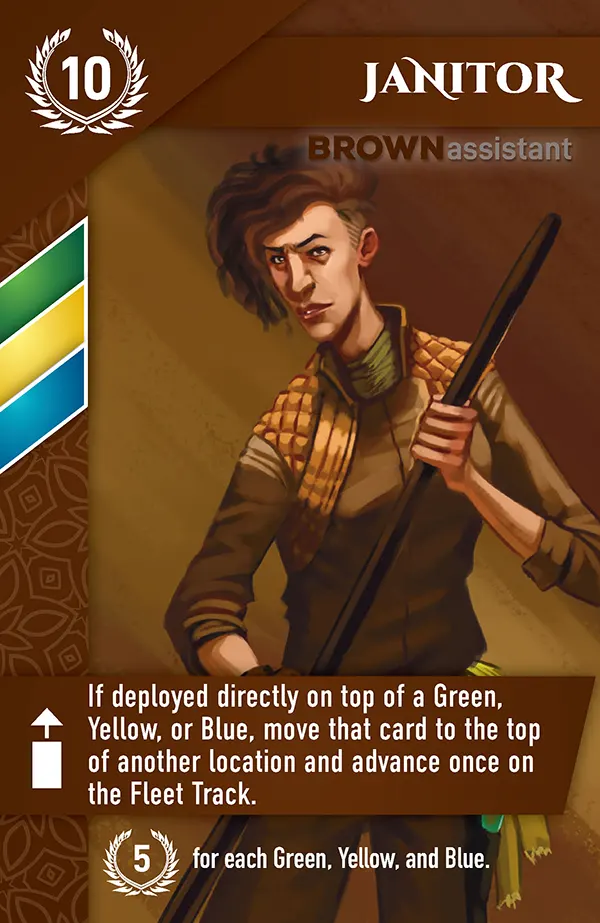
This scores points for each card in hand of the listed types.
“if with”/“if with no”

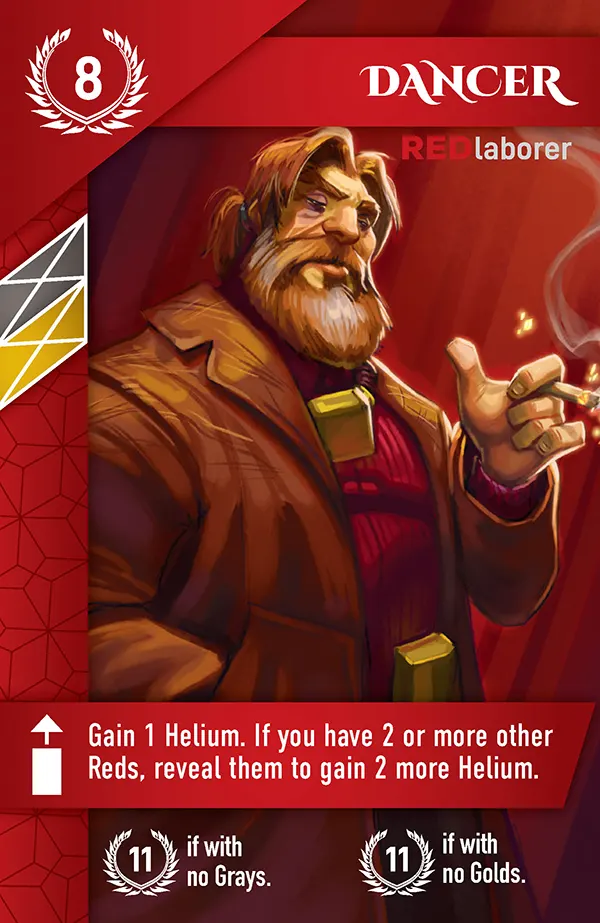
This scores points if you do or don’t have a certain card type or character in hand. It’s a binary condition—if it says “14 points if with a Silver,” you score 14 points total if you have one or more Silvers.
“for each [color] on all locations”

Unlike most end-game scoring, these end-game bonuses look at cards remaining on locations on the board, not cards in your hand.
“banished cards”

A few end-game bonuses refer to the pile of cards that were banished during the game. It doesn’t matter which player banished these cards.
Fleet Track
Score points based on your position on the Fleet Track (0–43 points).

Helium

Gain 3 points per Helium token.
Sovereignty
Gain 10 points if you have the Sovereign token.
Influence
The player(s) with the most Influence at the Institute gain 4 points for each of their Influence there. The player(s) with the second most Influence at the Institute gain 2 points per Influence. All other players gain 1 point per Influence.
- Note that in a 2-player game, 3 non-player Influence tokens start on the Institute. The 2 players will include those 3 tokens in the end-game comparison as if they were the Influence of a third house.
Excess cards
For each card in your hand beyond the 7th card, lose 10 points. At this time you’ve already accounted for other points from these cards—those points are still valid. This penalty represents the unwieldiness of managing a larger house and encourages players to focus on cards that work well together, not simply more cards.
The player with the highest score wins the game! A great final score is 300+ points.
If there is a tie for first place, the tied player with the Sovereign token wins.
If no tied player has the Sovereign token, share the victory.
She has a base score of 70 points. Add points to that in the steps below.
Points for Fleet Track, Helium tokens, the Sovereign token, and Influence as a human player.
Instead of scoring her hand like normal she gains the following:
Cards in her hand are matching if their core value is odd/even matching the visible word on the odd/even card placed during setup. Note that 0 is even.
Otherwise, they are nonmatching.
Sort her cards into matching and nonmatching.
Reduce Au Toma’s hand to 20 cards. Discard non-matching cards first, then matching till she has 20 left. Skip this step if she has 20 or fewer cards.
She gains 568101214 points per matching card and 234567 per nonmatching.
Scout Action
On your turn, either lead or scout. When you Scout:
Place (not deploy) it on any location, covering all but the name, color, and core value of the topmost card at that location.
Gain that location’s bonus.
Players typically only choose to Scout if they are completely satisfied with their hand.
Blues
Blues are the astronavigators and pilots of the Society, bred specifically to crew starships.
Browns
Browns work as servants in homes, businesses and social institutions; often seen as attendants, cooks, janitors, farmers or nannies.
Coppers
Coppers are the administrators, lawyers and bureaucrats of the Society. They hold positions of public affairs and administration.
Golds
Golds are the highest tier within the Society. They are fiercely intelligent, and are humanity's dominant caste.
Grays
Grays serve as the police, military and security personnel throughout the Society.
Greens
Greens are the programmers and developers of technology for the Society.
Obsidians
Obsidians are a tribal-like, “monstrous” race, only bred for war.
Oranges
Oranges are the mechanics of the Society and provide systems support upon starships and all manners of mechanical enterprises.
Pinks
Pinks are bred and trained for the physical arts of pleasure and sex.
Reds
Reds are the unskilled workers suited to brutal environments and menial service jobs.
Silvers
Silvers are the financiers and businessmen of the Society.
Violets
Violets are the creative class, the artists, musicians and performers of the Society.
Whites
Whites are the priests, priestesses and mentors that fulfill many of the religious, educational, and appraisal functions of the Society.
Yellows
Yellows are experts in medicines, human, and natural sciences. They are the doctors, psychologists and scientists of the Society.
Au Toma Components
- 22 Au Toma cards
- 4 Priority cards
- 1 double-sided Luna bonus card
- 1 double-sided odd/even and scoring card
- 2 double-sided Au Toma player aid cards
Au Toma Cards
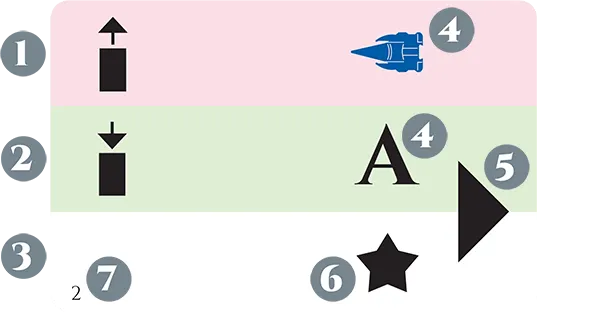
- Deploy character section
- Gain character section
- Extras section
- Location selection
- Location tiebreaker
- Bonus Indicator
- Card ID
- Luna Bonus Card
- Odd/Even & Scoring Card
- Priority Card
Effects on Tull Au Toma from Abilities You Activate
When you activate a deploy ability that (potentially) lets you either steal a character card from Au Toma or force her to banish one, use the bottom card of her hand.
Whenever Au Toma adds a card to her hand, or returns one after revealing it, she places it face down on the top of her hand.
If you activate an ability that allows Au Toma to gain something for free, she always chooses to do so.
Revealing Cards to Au Toma
Some cards instruct you to reveal one or more cards. Normally, you must show the cards to the other players, but Au Toma does not care so when playing against her you must simply have the specified card(s) in your hand.
Au Toma Luna Bonus Card
When Au Toma gains the Luna bonus (even if she does not actually get the Sovereign token) she also gains the bonus of the location indicated on the Luna card.
Tull Au Toma Takes a Turn
Au Toma takes her turn in the turn order as a human player. Follow this procedure:
If there are no cards left in the Au Toma deck: Form a new one by shuffling all the Au Toma deck cards, including those set off to the side previously, and set the topmost 4 cards off to the side like during setup.
Draw the 2 topmost Au Toma cards one at a time and perform the procedure below for each card, in the order you drew them. Fully resolve the first card before resolving the second. This means that Au Toma does 2 Lead actions per turn instead of just 1 like you do, and she never Scouts.
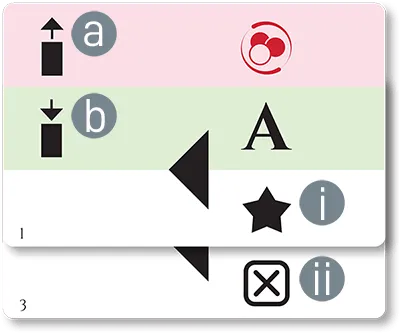 Deploy character: Place the top card of the character deck (not her hand) on the location chosen by the Deploy section of the Au Toma card. She does not trigger the deploy ability.
Gain character: Au Toma gains the top card of the location chosen by the Gain section of the Au Toma card. Place it face-down on the top of her hand.
Extras: If there is an icon in the extras section do this depending on the icon:
Au Toma gains the bonus of the location from which she gained a card.
Banish the top card of the character deck.
Discard the 2 Au Toma cards (you are allowed to look through her discarded cards at any time.)
Tull Au Toma Selects a Location
When Au Toma is to select a location for deployment or gaining a character, use the deploy or gain section of the current Au Toma card as applicable and follow this procedure:
If the section has a location icon, Au Toma selects that location.
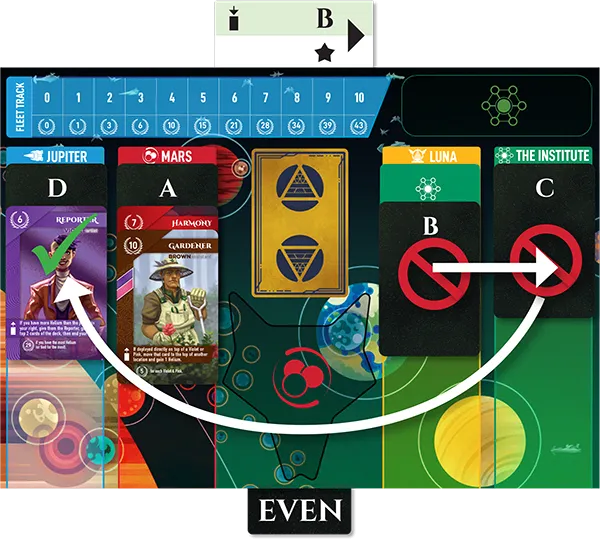
If the section instead has a letter, she chooses the location that has the priority card with that letter.
Empty locations can never be valid when gaining a character, so if Au Toma selects one do this:
Look at the arrow icon and start at the location she selected.
Move in the direction of the arrow until the first valid location is found. She selects that location instead. Wrap around from The Institute to Jupiter or vice versa as needed.
If she in any way would gain a bonus of which she already has 10 (10 Helium, position 10 on the Fleet track, or 10 Influence) she instead gains the bonus of another location (this does not change which card she gains).
Use the tiebreaker arrow as in step 3 until she reaches a location with a bonus of which she does not already have 10.
In case she gains the bonus via the Luna bonus card, she will still gain the Sovereign token in addition to the substitute bonus.
Au Toma Variant
This optional variant provides rules that handle your deployment of 4 of the 5 cards that are otherwise removed from the game, so that they can be included.
Auctioneer (Copper): Roll the Rising Die until you roll a bonus which Au Toma can get (e.g., not the Fleet Track if she’s already at position 10). She chooses that bonus.
Eo (Red): Look at the 6 topmost cards of her hand or all of them if she has fewer. Check for a Red then put the cards back down in the same order.
Psychologist (Yellow): For this comparison Au Toma has the number of cards in her hand divided by 3, rounded down.
- This number is calculated before reducing her hand to 20 cards (see Scoring).
Roque (Gold): Look at the 6 topmost cards of her hand or all of them if she has fewer. When you are done, shuffle and return them to the top of her hand.
Au Toma Difficulty levels
You can adjust the difficulty by changing how Tull Au Toma scores matching and nonmatching cards (1 is easiest, 6 is hardest):
| Level | Tull Au Toma | Matching | Nonmatching |
|---|---|---|---|
| 1 | High Red | 5 | 2 |
| 2 | Stained (Normal) | 6 | 3 |
| 3 | Lurcher | 8 | 4 |
| 4 | Master Maker | 10 | 5 |
| 5 | Carver | 12 | 6 |
| 6 | Peerless Scarred | 14 | 7 |